|
|


MYFORD ML7 Refurbishment I had to opportunity to purchase a 'scruffy' ML7 so I thought I would take a chance and buy it with the opportunity to tidy it up then see whether I keep it and sell my ML10 or vice versa. Time will tell. Myford Refurbishment 23rd February 2008 Session 1 After spending some time previously making the new bench , I started by stripping the lathe to see what was what. Then I tackled wiring the motor up to the switch (received with the lathe, in a bit of a bodged box). When received, the wires had been cut between the motor and the switch, so I had to work out what was what. The moment came to switch the motor on and it was with a bit of trepidation that I plugged it into the mains. It was even more ‘interesting’ to turn the Myford switch on….but was pleased when the motor ran both forwards and in reverse. I now need to buy a couple a couple of belts in anticipation of bolting it all together. I then spent the rest of my time in the workshop sanding and cleaning the electric motors case, and then spraying it in primer. That was it for today. Short and sweet in description but an hour or so of work. Time spent today 2 hours. Total to date 2 hours. ==================================================== 24th February 2008 session 2 Today the undercoat sprayed yesterday, was sanded down and the after cleaning, painted with the green Myford paint. I will repaint all of the lathe as whilst the rest of the lathe is a Myford green its certainly not the same as my paint! Yesterday evening I took the opportunity to paint the motors base plate. Allowing me to paint the motor whilst standing on its own base bracket. Short and sweet... Time spent today 30 minutes. Total to date 2hr 30 minutes. ==================================================== 25th February 2008 session 3 Had a brief 'preparatory' session today whereby I sealed the edges of the tray on the new bench, ready for a protective coating of Hammerite (black hammered finish). I needed to do this now if I wanted to put a coat of paint on tomorrow, prior to a wash down and clean of the lathe base prior to painting Time spent today 30 minutes. Total to date 3hrs ==================================================== 26th February 2008 session 3 Today I managed to paint over half the top tray now the sealant has hardened. Next time I will be able to locate and drill the correct location before completing the painting. I also took the opportunity to paint some of the framework. I then continued with the stripping down and inspecting parts prior to their repainting and I will need to buy a couple of bits but in the main I should say this lathe has sat a long time rather than being worked hard. There doesn't seem to be very much wear considering its age. Time spent today 1 hour. Total to date 4hours. ==================================================== 5th March 2008 session 4 With the lathe came the basis of the Dewhurst switch, housed in a rather makeshift housing of wood and aluminium. I decided to make a new housing, based on the switch housing supplied with my Myford ML10, from which I took the approximate dimensions. My switch case will be made from sheet steel and the rough sizes [photo 1 to the left] were cut by an air driven nibbler. The design requires 4 pieces of sheet steel. The top and bottom pieces [photo 2 on the left],the back, and the main body. The tops were cut using my Proxxon band saw and this tool will be used to make all the other cuts. Once the top tabs have been cut out the main body will be rolled into shape, then the two tabs at each end will be bent to 90deg, as will the top and bottom tags. Onto this rolled main body, the top and bottom cover will be welded or riveted. To ensure they were a matching pair, I used a file by drawing it over the two, when clamped together in the vice. The back will be screwed or bolted to the main body and a bracket will hold the new casing onto the lathe bench. The switch itself will be attached to the top plate and a new handle produced. I am at the cutting out stage at the moment, and will treat this as a bit of an infill to the Mills diesel engine construction. Time spent today 1 hour. Total to date 5hours. ==================================================== 19th January 2009 session 5 Since selling my much loved ML10 and seeing it depart on Sunday, I have been spending the proceeds! When stripping the ML7 lathe down I found a few issues and made a list as I went. This stopped when I concentrated on various other projects last year, including building the Mills 1.3cc diesel engine. When my brother very kindly moved the ML7 into the main workshop last week, it started a train of events leading directly to Sundays sale and funds for the ML7 rebuild. When I bought her on a whim last year. All right, I made a silly low bid on eBay, and never expected an email saying I had won it, and when was I going to pick it up from Scotland! Here is a picture of what she looked like in the beginning………..(surprised to see it was February last year!) When stripping the lathe down I was surprised that some parts were very worn whilst others were in good condition. Which leaves me to believe that the lathe has had some sort of refurbishment in the past. With a list of the parts needing replacement I phoned Myford and spoke to Malcolm in their parts section, giving him my order. Whilst on the phone I asked if Malcolm could date my particular lathe, which he kindly did. saying it left the Myford factory in 1953! Following the Myford call, I then phoned a company that supplies inverters/converters and electric motors. My ambition is to have an accurate lathe with variable speed motor control and digital readouts. So there’s a bit to go. There are a couple of shafts that I will have to have a closer look at. They are the lead screw end. Initially I thought that they were very worn indeed, but after cleaning it seems that they have been turned down to different sizes for certain lengths and the wear may not be too great. Time will tell. So the current situation is a lathe completely stripped down and major items are hand painted Myford green. A list of new parts have been ordered from the makers and a new variable speed motor system also ordered. Assembly will take place as far as possible from now on, only to be held up by delivery times. The digital readouts will have to be in phase two (need ot raise the remainder of the money - more expensive due to the £’s slump). Hopefully tomorrow there will be a few photo’s showing the reassembly process. |
Myford ML7 Refurbishment page - updated 25th February 2009 |
www.mikes-models.com |
20th January 2009 session 6 Today it was back to the paint brush and a bit of a surprise. The high quality paint brush I had been using did ok, but I thought the paint lay on a little thick at times. Today, because of the smaller mature of the items to paint, I got out a smaller artist type brush from a cheap set bought on the internet. The surprise was in the quality of finish. The cheap artist brush was gave a far better finish! Yesterday I ordered the new electric motor, inverter and remote control and today it arrived! Good service so far. The package also included three electric cables and some end fittings so a little study will be needed before it all goes together. I will let you know how it goes. The latest edition of Model Engineering Workshop arrived yesterday and included an article of a rev counter that seems a possibility for the ML7. Again if I go ahead with making one I will let you know how I get on. After the excitement of unpacking the new motor I then hunted around for the pulley that fitted the old motor. Needless to say the bore of the pulley didn't match the new motor but fortunately the shaft is larger than the bore so its just a case of boring out the pulley and cut a keyway. Something I have yet to do. With so many parts laid out around the workshop drying and the new motor unpacked, I thought it was time for a cup of tea, and a new list of action points. So the following list is the next phase of the refurbishment. I will let you know how I get on. I am now waiting for some handles from RDG Tools online and various items for Myford themselves. I must be honest I am really enjoying this refurbishment project, surprisingly so. I am treating the ML7 as a big set of castings and it's a good way to look ait I think. More to follow….. List of actions for Myford ML7 refurbishment 20th January 2009 1. Machine up an new counter shaft 2. Machine up a new leadscrew front shaft 3. Machine new phosphor bushes for leadscrew 4. Make new drawers for lathe bench 5. Make a sheet steel back and side plate for lathe bench 6. Make two raised blocks for lathe to stand on 7. Paint remaining front part of lathe bench with black hammerite 8. Make and fit front door to bench (either wood or sheet metal) 9. Make and fit shelves for lathe bench 10. Bore out and cut a keyway for new lathe motor 11. Make the rollers for the bench drawers to fit on 12. Fly cut top slide tool post area 13. Clean up and paint the leadscrew right hand side handle 14. Wire up and fit new electric motor 15. Wire up and fit new inverter 16. Wire up and fit remote (after giving some thought to position) 17. Check eBay for the following (new or good secondhand):- a. Rear tailstock handle b. Long cross slide So look back and in and see how I get on with reduce, then adding to the list! |
26th January 2009 session 7 Well I seemed to have missed writing up a few sessions, either that or progress has been slow. Perhaps it's a bit of both. Using the list above, the sheet metal (item 5), raised blocks (item 6) has been completed. So a start was made on reassembling the lathe by attaching the bracket that holds the counter shaft (takes the drive from the motor) and electric motor mounting pad, to the lathe body. The countershaft then became the focus of my attention. The first task was to remove the old iolite bushes, so a brass drift was turned to allow the bushes to be tapped out. It was then that I found that instead of one bush each side, there were two! So I needed to order two more from Myford and since I needed to make an order I added a set of 10 new 2BA oilers to it. Whilst it will take a few days to arrive, there is plenty of work still left to do! Putting the countershaft to one side I decided to fit the new electric motor and do the wiring needed. A new pin for the motor bracket had to be turned to replace one that was missing when the lathe was received. Also there was a grub screw that held against the pin that was damaged, so it was drilled through and a stud extractor tool used to remove the outer side of the grub screw. New grub screws were then cut to size and fitted to the aluminum casting(s). Having attached the motor bracket the new electric motor was placed upon it and one problem then clearly became visible. The input holes for the electric cable to the 3 phase motor were in the wrong place. Removing the top screws to the wiring box mounted on the motor, you see that this problem was easily resolved by removing the box outer shell, and turn it around to suit the side you wanted, so this was quickly resolved. Once the bracket was attached to the lathe bed I made a start on wiring up the new drive system. To help, all the lids were removed from the inverter, remote control and electric motor before making a call to the suppliers for guidance on how to wire up the three components. Dave from Indirect Drives was very helpful and patient! I made a diagram and read that back to Dave. Then a start was made by stripping the four core wire and attaching it to both the inverter and the electric motor, changing bars around the electric motor side. Tomorrow I will carry on with the wiring and get the system running before fitting the electric motor to the lathe motor mount. |
27th January 2009 session 8. Today I started by looking at the leadscrew and how I would make the bushes. I am still undecided as to what to do at the tailstock end but the headstock end requires a new shaft made and the bearings fitted to the aluminum housing are quite thick. Far more so than those supplied by Myford for the countershaft. Those are oilite bushes and I am not sure what those in the ead screw are. I could ream them to a convenient size and make the shaft to fit or I could make new bushes and bore them to the correct shaft size. I must admit that I am leaning towards new bushes and the correct size shaft. Putting this to one side I carried on wiring up the motor, inverter and remote control box to Dave's directions. I managed to get to just one query when reading my scribble. So a call was put in to Drive Direct, Nottingham to check the wiring was correct before switching on and dealing with the programming of the Inverter. I must compliment Dave on both his knowledge and ability to get the information across. After clearing up the wire I couldn't read on my scribble pad the motor was switched on and whilst nothing happened I was told by Dave that that in fact was a good sign! After step by step directions by Dave the motor was not only running silently, but the variable control was great. I am very pleased with the set up I have got even if I spent a little more than I planned for. The control and engine of this lathe will certainly not be its weak point. Dave was extremely busy at the time of my wiring up, giving help to other customers BUT they never failed to call back, ever. Many other firms could benefit from there example. So a public thank you Dave. The next task was to plan where the inverter and remote control box would be positioned. The inverter was quickly sorted out and screwed the the wall by the power socket outlet. The control box is a little more complicated as until the lathe is working properly its a little difficult to decide on its final position so I placed a clamp on the bench in the place I think will be ok, but I shall make a fixture to hold it and finally fix after a little practical experience shows me the best operating place. The next task I have started is to make the pulley fit the shaft and cut the keyway so hopefully tomorrow the pulley will be ready to be fitted to the new motors shaft. |
28th January 2009 Session 9 The main target to day was to complete the machining of the motor pulley and start rebuilding the Myford ML7 lathe. Boring of the 0.750" diameter hole proceeded with little drama if a little slowly. Once done to a nice snug fit, the next task was to cut the key way. Now I must admit that whilst I have read about the procedure in the past I have not had cause to cut one. My starting point was to finds some tool steel of the same width as the key on the motor shaft, then grind the end of the tool steel to my own cutting profile. When done, I started by isolating the lathe from the power supply, to make sure I didn't do anything silly! I placed the tools steel in the same position on the tool post as a boring bar but the cutting face on its side facing me. I thought it would be useful to make a mark on the pulley of where the key way was to be made and proceeded to make the first cut using the top slide. By only moving the cross slide out by 1 thou (0.001")of an inch made another cut. After a short time a nice keyway started to be formed but I was concerned as the amount of pressure being placed on the top slide. So I decided to use the cross slides main hand wheel instead, and keep the top slide closed. This certainly helped to speed up the process and felt a more comfortable a solution. I will make a fixture for future use (add it to the ever growing list of tools to make!) which isolates the need to cross or top slide to be used. There are various examples in books and magazines and no doubt there will be many more keyways out there waiting to be made……… One silly mistake I made was to just cut the keyway where the pulley ended up when secured in the 3 jaw chuck. When trying the fit I was pleased, only then to find that the keyway position meant the grub screw used to secure the pulley was now partly over the pulley key! All I had to do was to take note BEFORE I made the keyway of where the tapped hole was. Not a great problem, but now I needed to drill and tap for a new grub screw. After the pulley was cleaned up a little it was provisionally fitted to the motor on its bracket. What next I asked myself? Well there were several boxes holding various screws, bolts and other fixtures so I though a general reorganization of parts would be useful. So I set up a table and sorted out all the parts of the great mechanical puzzle so I could see what was what to re-assemble the lathe. When the parts were sorted I thought the best way forward now was to put together as much as I could even if it had to come apart again when the parts from Myford arrive. A start was made by putting the tailstock back onto the lathe and it's a part I think I will have to have another look at as it could be better. The next item assembled was the cross slide and saddle. The lead screw lock nuts were oiled up and the gib strip fitted. When looking at the cross slide I decided that since the fixings are metric (!) I would treat the lathe to new bolts. A new handle was fitted (not impressed with the handles sourced from a non Myford source) and I may have to make a small sleeve to match the difference between the handle bore and the saddle pin. Not a great difference and the handle tightens with the grub screw, but not really satisfactory. Another add it to the list item. I have thought several times that the lathe has had work done on her before, and now I am certain. When I took the lathe apart I religiously kept everything in different small containers. Now putting the cross slide back together I couldn't find any laminate shims that fit between the cross slide and two plates that fit under the top of the lathe bed and the base of the cross slide. There must have been something because the cross slide will not move if the securing bolts are fully tightened, and I remember it moving when the lathe arrived (or at least I think it did…) So they will need to be purchased (that will be the third order!) and because of this omission I have decided that the lathe will be completely re-assembled and only then will I make the 3rd order from Myford. When the parts arrive the relevant parts will be disassembled and new ones fitted. So that's what I will do. So far the tailstock has been fitted along with the motor bracket and cross slide and saddle. The lead screw has also be partly fitted. All in all not too bad a day. |
29th January 2009 Didn't feel up to much today so carried on for a short time with re-assembly of the Myford then the rest of the time sourcing material and a new lead screw! On the HMEM forum I am giving a running commentary on the refurbishment when one of the contributors sent the following reply:- |
"Mike, I had to do this a few years ago when I completely rebuilt my ML7, including making a new leadscrew. The front drive shaft for the leadscrew was unhardened EN8 as supplied from Myford. The easiest replacement - with a ground finish - is a piece of 5/8" silver steel, and will probably last another lifetime. You do need a woodruff key cutter though, to fit the drive gear on the end. The original bearings in that end (there are 2, with an oil gap in the middle) are Oilite. I ordered a pair from Myfords and found they were around 2mm too small on diameter, but they insisted that these were the correct part number, and were all they would supply. Boring and reaming can 'smear' and block the pores on Oilites, so I turned up a pair of bushes from LB4 leaded bronze instead. Don't be tempted to use Phosphor Bronze with an unhardened shaft though. Also turned up another leaded bronze bush for the other end of the leadscrew. If your leadscrew is badly worn, as mine was, the tailstock end will give you a problem as the shaft will have worn undersize, but the thread on the end (7/16"?) is the same size as the shaft, so you cant really turn the shaft down and use a smaller bush, unless you downsize the threaded part at the same time. For me, the easiest solution was to buy a bit of leadscrew stock from Kingston Engineering http://www.kingston-engineering.co.uk/ and make a new one. Much cheaper than Myfords too. Good luck with the rebuild and keep us posted. Peter" |
After checking the dimensions of the Myford ML7 leadscrew I contacted Kingston Engineering and they were very helpful. So I ordered a 1/2 section (30") and will let you know how I get on when it arrives. |
31st January 2009 This morning started with a little apprehension and some careful machining. The countershaft was close to the outside diameter to fit the newly arrived last pair of oilite bushes. I was so close to the finish that a mistake would write off all the work done to date and the only steel bar I had of suitable size. Well things went well and I managed to get a very nice fit when testing them on the countershaft casting. So I faced the ends to finished overall size. Removing the shaft and feeling a little smug moved over to the bench to have a trial assembly. Imagine my disappointment then that whilst the shaft was a nice snug fit when put into one end only, it would not go through both. Not wanting to damage the shaft I had a close look at the casting and was surprised that when looking at the set of bushes that the shaft was about to enter, there was about an 1/8th of an inch gap on one side! Removing the shaft I looked at the casting end on and one of the forks, or legs of the casting, was out by this 1/8th of an inch. What to do? Well the first thought was to find a second hand replacement. Boring through both was quickly dismissed as not viable, so I thought since it would need replacing there would be no danger in trying to get them back in line. Putting one leg securely in the vice, I gave the leg a gentle couple of 'taps' with a heavy peen hammer. Imagine my surprise when removing the casting to check it I found that both legs now seemed in line. A tentative trial of putting the new shaft through found that not only was it a good fit, it was a great fit! Using the correct Myford oil (bought on eBay) a few turns were made where no perceivable movement could be discerned and no tight spots felt. It was with even more apprehension that I then moved the bar back to the lathe to cut the groove using the parting tool. It was then over to the milling machine to cut the two shallow slots at each end. My lathe seems to be of a different design to those that came later (mine was made in 1953) and the woodruff keys didn't exist on my shaft. This was reinforced by the fact that no keyways were cut in the pulley or other fittings. So the new shaft replicated everything the old shaft had. This meant drilling a hole in the centre of the turned slot. You can see the comparison of new and old shafts in the photo depicting both old, and finished new shaft. With the new shaft now finished and fitting well within the new bushes and countershaft casting, I decided to complete the counter shaft assembly. A start was made by trial fitting each component. The three pulley group was inspected and whilst a slacker fit on the shaft I decided to trial fit it to see how secure it would be. The two grub screws were removed and cleaned up and remembering to firstly fit the new rubber bushes, the shaft was put through the countershaft casting, through the pulley and out the other side. The hole on the slot was put uppermost and the smaller of the two grub screws (checked that it fitted earlier) was tightened. Then the larger screw was screwed in and the shaft seemed to be secured very well. The only two remaining items to fit were the new 2BA oilers, but first I cleaned the threads out with a 2BA tap. That completed the bench based work and the whole assembly was taken over to the lathe and temporarily secured. The next item to fit was the large pulley on the outside of the countershaft bracket, but first the new thrust washer was placed on the shaft between the pulley and the main casting. All that was left to do now was to secure the opposite end. This required a spacer to be made. I couldn't find one so checked the photo's of when it was taken apart and was surprised to find it didn't have one. I could have removed the shaft and cut a further slot for the screw to bed down on, but thought it would be better to make a spacer. When checking my bar stock I didn't have any steel of the correct outside dimension. So I decided to make a temporary spacer from aluminum and order some steel to make a permanent one from. I don't thing the aluminum is a long term solution. So having turned up the spacer, the end shaft stop was secured after setting the end float to 0.005" using feeler gauges (see photo). Now the countershaft was in place I could see that the motor and its bracket will need some adjustment. A view further reinforced when trial fitting the new belt which seems awfully small to me (but the countershaft to headstock seems minute!) but it has yet to be set up. Overall one of the better days work, certainly better than the last week or so! You never know I may even get her 'breathing' tomorrow, using her new variable speed motor, and I am now much nearer the end than the beginning. |
Please allow time for the gallery to load.....thanks |
1st February 2009 Today there was some success, some close calls regarding decision making and a little frustration at leaving the workshop before I wanted too. First the close calls. When trial fitting the engine there didn't seem to be much allowance on the travel the motor could make to allow the new drive belt to be fitted. On closer inspection the problem was the top electrical box on the new three phase electrical motor, which came into contact with the countershaft main bracket bolted to the back of the lathe. To get the motor to fit in the required position my thoughts went from drilling new mounting holes in the motor base bracket, to making a new engine mounting system altogether. However when striping the whole system down and inspecting the new electric motor, there seemed to be tapings all around it. Since I thought I had been smart earlier when I turned the electrical connections box around, then why not move the position of the box again. There was the difficulty that the wires from the motor would have to be moved as well so that idea went straight out of the window! Turning the motor around, the feet were only secured by two screws, and yes the positions of the other tapped holes all around the motor meant that the engine designers had built a very flexible mounting system. So in the end it was a simple case of unbolting the two feet and position them on another side, allowing the wiring box to be away from the back of the lathe. Just imagine the difficulties I could have produced for myself if I had continued on one of the paths earlier! Now bolting the motor to the Myford motor base was simple and also in exactly the right position. Not only had that but the drive belt from the motor shaft to the countershaft fit perfectly. Reading the Myford manual the previous evening, one of the important set up items was to position the two connecting pulleys in line. To do this task a straight edge is all that is required. The same procedure should be used to align the counter shaft pulleys with those on the headstock. And here I came across another supposed problem which yesterday I actually thought I had been clever and cured. The spacer I made for the right hand outside of the counter shaft wasn't there when I dismantled the lathe for one simple reason, it's not needed! To line up the two pulleys the spacer had to be moved because the countershaft pulley had to be moved over to the left (funny it was the same amount as the spacer eh!) and the outside large belt wheel takes up the movement required! So after the necessary adjustments were made, and with the power off, I moved the motor pulley and since there didn't seem to be any restrictions or tight spots, I threw the power switch and everything burst into life. I thought it would be useful to run the new bearings in a little and after using the Myford oiler via the two new oil nipples, the countershaft was allowed to run at varying speeds and change of direction. All seemed to be running smoothly and I can't wait to turn some metal. The variable speed motor system is really excellent and I would say its nicer in its variation than the large Turner far Eastern lathe I have. The next item to be made was the shaft that lies under the countershaft (see picture below) and I tried to remove the cotter that runs through the large part which holds the handle, with little success. SO I decided it would be quicker to make the complete assembly. After finding the BMS bar and cutting it to size I thought I would turn the whole shaft and handle, from one piece, but this would be a lot of lathe work. So the plan changed and the part will be made from three items, the main shaft, the handle and the boss that holds both the handle and shaft. The first part has been turned and the hole drilled to accept the shaft which only needs cutting to length, face the end and then mill the two slots. All of which should be completed tomorrow. |
2nd February 2009 Today I only managed to complete the lever that releases tension on the countershaft/headstock belt. It is surprising to me still on how much I underestimate time required for each task. No real problems were encountered and I had a chance to use my tailstock die holder for the first time, and it was great. One problem I did encounter however was the size of the aluminum ball for the end of the shaft. My ball turning tool I built to make the chess set was too small for the size of ball I wanted to turn so a compromise size had to be made.However it will do the job and I can make a larger one if I want to later on when I make a Mk2 version. When fitting the shaft everything fitted nicely so it was a job worth doing. The next stage will be to carry on with the rebuild. Stop press: The leadscrew has just been delivered so tomorrow I will start on making the new leadscrew. |
Sunday 8th February 2009 Not been to well this week so the last couple of days have been sorting out some 'odds and ends' but surprisingly those odds and sods have seen quite a bit of the lathe come together and the long list of to do jobs, disappear. The only large scale job left is the leadscrew and I am waiting for some reamers and other tooling to arrive before I can tackle that job. I did waste some time cursing a previous owner for the bracket made to hold the belt guard for the motor to countershaft. When fitted, the belt was off centre to the cover, but it was a simple case of the belt tensioning shaft being off and it should have been off centre! I only saw this after making a new bracket, then a spacer to put it exactly where the original bracket positioned it! Double Doh is an understatement. Another silly waste of time was hunting down the bracing bracket between the motor base and countershaft casting. Where was it? Secured to the countershaft casting and just hanging loose! When putting the bracket to its position there was an obvious need to a spacer so I turned up a new one only to find the original on the table of spares later on! But that's only to be expected when I am as dopey as I am at the moment. Today I cleaned up and assembled the cross slide thread assembly and made a sheet steel shelf to attach to the splash back of the lathe stand. I wanted to bash a bit of metal and so I did, only making me worse that I was to start with……..so a week of unenforced errors really, no great drama's just poor concentration and the little time I spent in the workshop, squandered. So it comes as a great surprise to see how much of the lathe has been completed. Next week the reamers and other goodies will arrive and whilst I have had the cleaned (but hard used!)3 jaw chuck moving I may get to turn some bar on it by the end of the week! We will see as they say……….. |
Monday 9th February 2009 I have worked out why the last few days haven't gone well ………. Because I couldn't progress the Myford refurbishment I thought I would return the Seal engine project. Since I needed to make a new inline boring bar to bore through the cylinder block casting that was the first job started today. I thought it would be nice to use a part from the Myford for the boring bar. So the kn^&ck%d countershaft will be turned into an inline boring bar, so every time I use it I will remember the refurbishment. After turning the shaft down sufficiently to get rid of the wear and scoring, I removed it and took it over to the milling machine. I was about to drill two different diameter holes for tool steel, followed by two 5mm tapped hole for grub screws at 90° to them when SWMBO arrived with a large parcel. So after unpacking the heavy parcel containing a new 4 jaw chuck for the Myford, and the necessary reamers for the bushes for the leadscrew, I could at last start on the only major part left to make for the Myford ML7, the leadscrew. I put the boring bar idea to one side and removed the two leadscrew bearing castings from the lathe. Then I pressed out the old bushes using the' old 2 socket method' (see photo gallery). Both sets of old bearings came out easily, so the Colphos 90 was brought out of the stock room (aka the en-suite) so the 4 bushes required could be made. It became obvious quite early on however that I had made another error when buying the metal. My leaded bronze was big enough for the right hand side bearings, but was too small for the left hand, or gear side! I had assumed (wrongly) that the housings would have the same internal diameter, and of course they didn't. I then spent a horrendous amount of money ordering just 6" of 1" diameter Colphos, and will now have to wait until it arrives before I can complete the lathe work. Double Doh! It was one step forward and 1 and a ½ steps back! It's a good job I don't employ myself, for if I did, I would have sacked myself! After muttering under my breath for a while, I decide that I could at least go back to the inline boring bar, but then I thought that because the leadscrew project contains 5 or 6 different tasks, I could at least make a start on the right hand side of the leadscrew. Decision made, the bronze bar was chucked and faced off. The keeping the minimum amount of bar out of the chuck I turned down the outside diameter of the new bushes using the half method. and got the finished size to half a thou larger than the existing oilite bushes. The next task was to drill out and then ream the internal diameter. I used three progressively larger sizes of drills (after the centre drill) giving a hole slightly undersized, before using one of the new reamers to clean up the bush to the finished internal diameter. When checking the dimensions of the old bushes I was surprised that the length of the two removed to find that they were different. So just in case I parted off both new bushes to the same length as the old ones. Once they were cleaned up I pressed them back into the bracket casting before running the reamer through both just to make sure they went in square( which happily they did - see photo gallery). And that was enough for today. Tomorrow I will take my life in my hands and turn down the left hand side of the new leadscrew to match the bearings and threaded end for the handle. After that I will be able to drill through the joining piece (see photo gallery) and ream to size before turning down the other end of the leadscrew. Hopefully by the time I have finished all the tasks I can still do, the 1" diameter Colphos bronze will have arrived so in the end little time, if any will have been lost. Perhaps I will take myself back on again………you never know……watch this space. So the answer to why things haven't gone well in the past few days is simply really. I must have been frustrated more than I thought by waiting for the parts to arrive. |
Saturday 14th February 2009 Well unfortunateley I have not managed to get out into the workshop over the last few days. Managed a short fishing trip but am still revovering even though I managed an hour today. However the position I am now in is the leadscrew has been fully machined and only the end shaft from the leadscrew to the gear end, has yet to be made. It should be to long now before the refurbishment has been completed! A start has been made on turning up the two new bushes for the right hand side of the leadscrew and I would now hope to get back to the Seal engine before the end of next week. Perhaps doing the inline boring on the refurbed Myford? We'll see. |
Sunday 15th February 2009 I managed to get out into the workshop today, and spend the morning there. The two bushes for the left hand or gear end of the leadscrew were turned, bored and parted off to size with little drama. When looking for material to make the shaft that fits the left hand side of the leadscrew, I could only find a piece that I had set aside for my boring bar! I will have to order some more stock for the boring bar as finishing the Myford refurbishment is my highest priority at the moment. After setting the bar to run true in the four jaw chuck, with just enough showing to allow the DTI to sit on, it was faced off then centre drilled to allow the revolving centre to be used for turning. The 4 jaw was then opened enough to take the bar far enough out to turn the outside diameter to size over its length. With the live centre in place, the 4 jaw chuck was then tightened and set to run true again with the DTI. Once the shaft was running true I started to make the first cut but couldn't get the speed and feed to run without chatter. So I did the same as when turning the contra shaft, and ran the lathe very slowly at 90 rpm and the leadscrew at its finest setting. The length to be cut means that this is a slow job. Fortunately there isn't a lot to take off and I do get a good finish using this method. Whilst the Turner lathe was doing its bit I spent some time tidying up some of the outstanding jobs on the Myford, such as replacing oil nipples and removing the belt tensioning shaft, so it can be drilled and a new roller pin fitted. I did take the opportunity to also clean the parts and then apply metal adhesive, so it won't need to rely on the roller pin to take the strain. The gears that came with the lathe were checked against the sizes for turning the leadscrew at its finest feed (0.0018 from memory) and sorted the gears out ready to attach when the leadscrew is complete. I seem to have some additional sizes, 2 x 80 teeth and a 127 tooth gear! I am however missing a 75 tooth gear so will have to seek one out. The gear guide was placed into the gear cover and secured and one or two other small jobs done reducing the work left after the leadscrew shaft is completed. I am hoping to complete the complete refurbishment by the end of next week subject as always to health issues. It will be nice to get back to building the seal engine and I am looking forward to making the camshaft using Steve Huck's method and cutting chart. Look back and see how I am getting on. |
Wednesday 18th February 2009 Today I managed to finish turning the last shaft, which fits between the leadscrew and the gear to turn the leadscrew itself. The joining adaptor was also bored and reamed to fit the new shaft. All that now remains to do on the leadscrew assembly is to mill the long slot on the recently completed shaft, and drill a couple of holes for roller pins and glue the joints. The last few items to be assembled showed up more items that really should be replaced. The two under saddle plates in particular. Also no shims existed and these would definitely need to be installed. I could not locate the leadscrew nut for the cross slide and am not sure it was even there when the lathe arrived. So it was a case of phoning Malcolm at Myfords and make my third and hopefully final order. which means that whilst I should definitely complete the refurbishment in the sense of making new parts, the final assembly will have to wait upon the delivery from Myford. It seems that it was a good job I phoned Malcolm as he very kindly explained the method of shimming the saddle. There are 5 shims needed and at just under £5 a piece they are not cheap at first sight. However they are made up of various layers and they can be stripped off to get the right size. I will do a write up of the procedure on my main website with photo's (fingers crossed!) next week and it is not simply a case of putting them between the plates and the saddle (I also took the opportunity of buying two new plates as well). I did however use the Myford lathe for the very first time today! It may only have been to clean up the end of the new shaft from burr's but it was used! When the project is complete I will list the costs incurred and an approximation of the time taken. It may make 'interesting' reading. |
Thursday 19th february 2009 Today I have almost completed the Myford leadscrew. All that is left is to drill the two holes at 90° to each other to locate the two spring roller pins. The first task this morning was to mill the small 1/8" slot to for the gear drive pin to locate in. I got into a mental mess with including, excluding, dividing the end mill in half to measure the length of the cut. However it must be because I am finally learning that a light first cut showed me the way although there is a slight overcut on the top cut. The rest of the milling job went well and the pin fitted just right, allowing a gear to fit snugly in place (see photo gallery). The next job was to set up the whole leadscrew and work out the position of the joint so the length would be correct. In fact it didn't need sorting and I suppose I can thank Myford for that. Since I made the constituent parts to the same dimensions as the original, all the parts fitted as they should. One headache less, I decided that the best way forward would be to clean the end of the leadscrew, the right hand shaft and the joint piece. I then used Delta 55 high strength retainer adhesive to hold the three pieces together and tomorrow that should help when I pin them. I must admit I don't have a great deal of confidence when gluing metal. It doesn't seem right, although I know industry relies on adhesive in a great many situations. It's only time and experience I suspect before I gain that confidence as I have read many articles where model engineers rely on such adhesives. The post lady then turned up with a nut for the cross slide only ordered yesterday! Many thanks Malcolm. So as soon as the other outstanding items arrive, the lathe refurbishment will be complete. I have enjoyed the rebuild far more than I ever thought. I shall have to be very careful I don't buy another…….. (no, no……!!!!!!!!!) |
Saturday 21st February 2009 For the second day running I didn't manage to stay out in the workshop for as long as I would have liked. However I did manage to pin the leadscrew and fit it permanently to the lathe so that was a positive. Even better was the smooth and free turning nature of the leadscrew after final fitting. I decided that to cheer myself up, I would connect up the gear train and run the lathe at various speeds to 'run in' the new bearings of the counter shaft and leadscrew. However I was soon to discover that the gear wheel changing on this 1953 version of the ML7 had a really frustrating gear change set up! On my much loved ML10 (and the same for the ML7 according to the later manual I have) you simply unscrewed the retaining screw on the end of the pillar on which the gears seat. Not so my lathe! The screws on the end are in fact bolts on mine. They fit into two bolts with indents that fit into the rear of the gear casting. The hollow pillar through which the bolt goes then has another keyed bush that fits inside the keyway cut gear. The length of the pillar is more than the width of two gears and the screw is the same outside diameter as the inner pillar. So if you want to change gears you have to take the whole bolt, pillar and special nut off the casting. Since there isn't a lot of room between the casting and the lathe body this is a fiddly (bl*&^^y frustrating!!!!) job. I now understand why many owners either bought or built gearboxes! I will have to sort the problem out, but for now I have packed the gap with two large washers to fill the gap (about 3/16") and a smaller washer for the bolt head to seat against. This works fine but it isn't an 'engineered' solution (see I am getting posh now). It may be a simple case of reducing the overall diameter of the pillars (cant see that Myford would have allowed this situation so there must be something wrong -let me know) or buying a pair of 'modern' replacement fittings from Myford. It may be just a 'bodge' from a previous owner which I suspect is the true reason for the discrepancy. However the gears were eventually fitted after discovering my driver gear may be an accessory rather than the standard gear. After much head scratching I found a set of gears that I had and would give a fine feed. I need another gear to get the finest feed, but I just wanted to get the leadscrew to turn over for now. And turnover it did, after all the oil nipples were given a generous amount of Myford recommended oil I rand the motor on a slow speed at first, in both forward and reverse directions, before speeding up, then varying the speed. The whole gear end of the lathe (I believe the tumbler gears are known for there noise) is a lot noisier than my ML10……. However that may change with the gear cover on. The leadscrew seemed to run as true as it should with the naked eye. So I would consider the whole exercise a success in regard to making the new shafts and leadscrew. My thanks go to members of the HMEM forum for their ideas and support during this project and in particular to Peter who told me about a supplier for the leadscrew threaded rod. Whilst it is not finished, all the large 'engineering' tasks have been done leaving just a few items outstanding waiting for parts from Myford. I would say it is 90% finished and less than a days work left. |
Now covered over, the refurbishment and rebuild has now been completed and she is ready to start work! Just needs to be bolted down and adjusted to turn true. Thanks to all those who gave advice. |
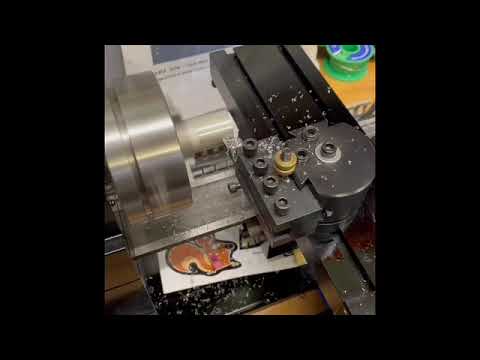
Wednesday 25th February 2009 Well I am pleased to say the Myford ML7 lathe refurbishment and rebuild has been completed! My first piece of metal bar has been turned (see photo) successfully if nervously. There are a few items still to be done but other than bolting the lathe down, they are just adjustments. Such as the main motor belt guard is catching the large pulley somewhere and the gear guard won't go on because of the top filling/storage cabinet doesn't give enough clearance when the gears are fitted. I also have decided to make a new steel tool post and holder system as I have on my other lathe and two new gear studs as fitted to my ML10 and later ML7 lathes. Then there are the drawers and front door for the bench below and that should be about it. None of which stops me from using the lathe however the next job will be to bolt the lathe down and use the test procedure to make sure the lathe turns true before any serious work is started or done. However I must admit to a little smile at the smooth cutting of the aluminum………. Today started with the fitting of the parts recently arrived from Myford (although some will have to go back as they are not correct). Starting with the fitting of the saddle and using the clever shims that cost around £5 each! Malcolm, from Myford told me when I ordered the parts that the shims come apart at around 0.015" a layer. They are separated by flicking the edge of the shim and then the layer pulled off. To shim the saddle you start at the back right hand side and using a dial indicator measure how much movement you get if trying to lift the saddle. The aim is to get under 0.0015" movement all around. The first attempt saw the saddle fit within the tolerance level set, however when trying to move the saddle the length of the available lathe bed, it became stiff when moving toward the tailstock. My immediate thought was the bed being worn more than I thought. Before making any further adjustments I remembered that I had only adjusted the saddle gib strip approximately and after a proper adjustment the saddle moved freely across its range with only about 0.001" movement of the saddle on the right hand front side. With the saddle adjustment made the next job was to adjust the top slide and cross slide and then with a little trepidation I chucked some bar and made the cuts. I have enjoyed the refurbishment although I will be glad to get back to making the Seal 4 cylinder engine but that may have to wait for a few days since I will be helping my brother, Steve, with sorting our fishing boat out after all the smoke and oil that escaped from the engine after our last trip! If you want to know more follow this link to our Dartmouth fishing site. If you are considering refurbishing your Myford then all I would say is go for it! Malcolm and Sarah at Myfords are a great help. I also want to thank all of you who have given advice and guidance to me along the way. |